How to Recharge a Portable Power Station with a Gas Generator (Hybrid Setup)
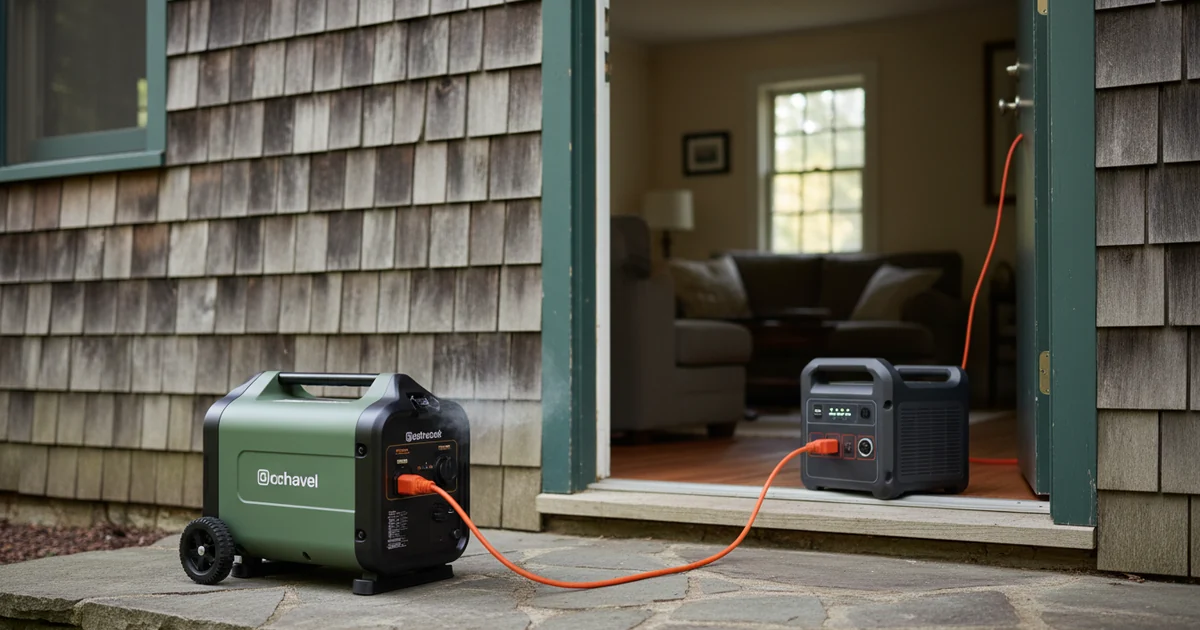
Running a gas generator nonstop for a 150W refrigerator wastes 8 to 12 gallons of fuel daily. In a hybrid setup, run a quiet pure sine inverter generator at 1,400W for 2 hours to refill a 3kWh power station, then shut the engine off for 20+ hours of silent indoor battery power.
01 Why Does a Hybrid Power Station + Inverter Generator Cut Fuel Burn by 70%?
Gasoline engines hit peak thermal efficiency around 60% to 75% load and waste massive fuel idling at 150W overnight. A portable generator running nonstop for 72 hours burns 30 to 50 gallons of gas.
Instead, pair a BLUETTI Elite 300 or EcoFlow DELTA 3 Ultra with a quiet Honda EU2200i. Two hours of high-efficiency charging burns roughly 0.4 gallons of fuel and powers silent household essentials for an entire day.
| Backup Strategy (72-Hr Outage) | Engine Run Hours | Estimated Gasoline Burn | Overnight Noise |
|---|---|---|---|
| Open-Frame Gas Generator Only | 72 Hours | 36 to 52 Gallons | 74 dBA All Night |
| Quiet 2,200W Inverter Only | 72 Hours | 9 to 12 Gallons | 48 to 52 dBA |
| Hybrid 3kWh LFP + 2,200W Inverter | 6 to 8 Hours Total | 1.5 to 2.5 Gallons | 0 dBA Indoors |
02 Why Do Conventional Open-Frame Generators Fail to Charge Some Power Stations?
Modern LiFePO4 power stations monitor AC frequency (60 Hz) and waveform purity tightly before closing their internal fast-charge relays. Dirty 15% to 23% THD power from cheap conventional generators frequently causes charging dropouts or relay clicking.
Always recharge from a pure sine wave inverter generator (<3% THD), or lower the power station AC charging rate in the smartphone app to 800W-1,200W so the generator governor holds steady frequency.
- Set AC charging speed in the EcoFlow or BLUETTI app to 70%-80% of the generator continuous rating (for example, 1,200W on a 1,800W Honda EU2200i).
- Turn Eco Mode OFF on the gas generator while fast-charging so RPM never hunts under sudden current ramp.
- Check if your station supports dedicated DC generator charging (such as EcoFlow Smart Generator or 48V DC chargers) to bypass AC-to-DC losses.
03 Step-by-Step Hybrid Charging Safety Checklist
Keep the gas generator at least 20 feet outdoors downwind while the power station sits dry indoors beside your refrigerator. Run a single heavy 12 AWG outdoor extension cord through a cracked door seal only during the 2-hour daytime recharge window.
Compare exact 5-year fuel and hardware costs in our Solar vs Gas TCO Calculator.
- 1 Throttle App Charge Speed: Lower AC input wattage to 1,000W-1,400W on a 2,200W inverter before plugging in.
- 2 Disable Generator Eco Mode: Flip Eco throttle OFF so engine voltage and 60 Hz frequency stay rock solid.
- 3 Charge to 85%-90% & Shut Down: Stop once fast charging tapers near 90% to save fuel, then run silently indoors.
- Hybrid battery-plus-inverter setups reduce 72-hour blackout fuel burn from 36+ gallons down to ~2 gallons.
- Pure sine wave inverter generators (<3% THD) charge EcoFlow and BLUETTI units cleanly without relay faults.
- Always turn Eco Mode OFF and set AC charge input to 70%-80% of your generator rated continuous watts.
Frequently Asked Questions
Q: Can I charge a portable power station with a dirty conventional non-inverter generator?
Sometimes, if you lower the power station AC charging rate to 400W-600W and enable Grid Self-Adaptation or Dirty Grid mode in the app. However, pure sine inverter generators or dedicated 48V DC chargers are far more reliable.
Q: Will charging at 1,800W overload a Honda EU2200i?
Yes, 1,800W sits at 100% of the EU2200i continuous rating. Cap app AC charging at 1,300W to 1,400W so the engine runs cool and avoids tripping overload protection.
Q: Can I leave appliances plugged into the power station while recharging from a gas generator?
Yes, pass-through charging powers connected loads directly, though total pass-through plus battery recharge current cannot exceed your generator continuous watt limit.